Civil War Review: Alex Garland's American Nightmare
Films.io Editorial
5 min read
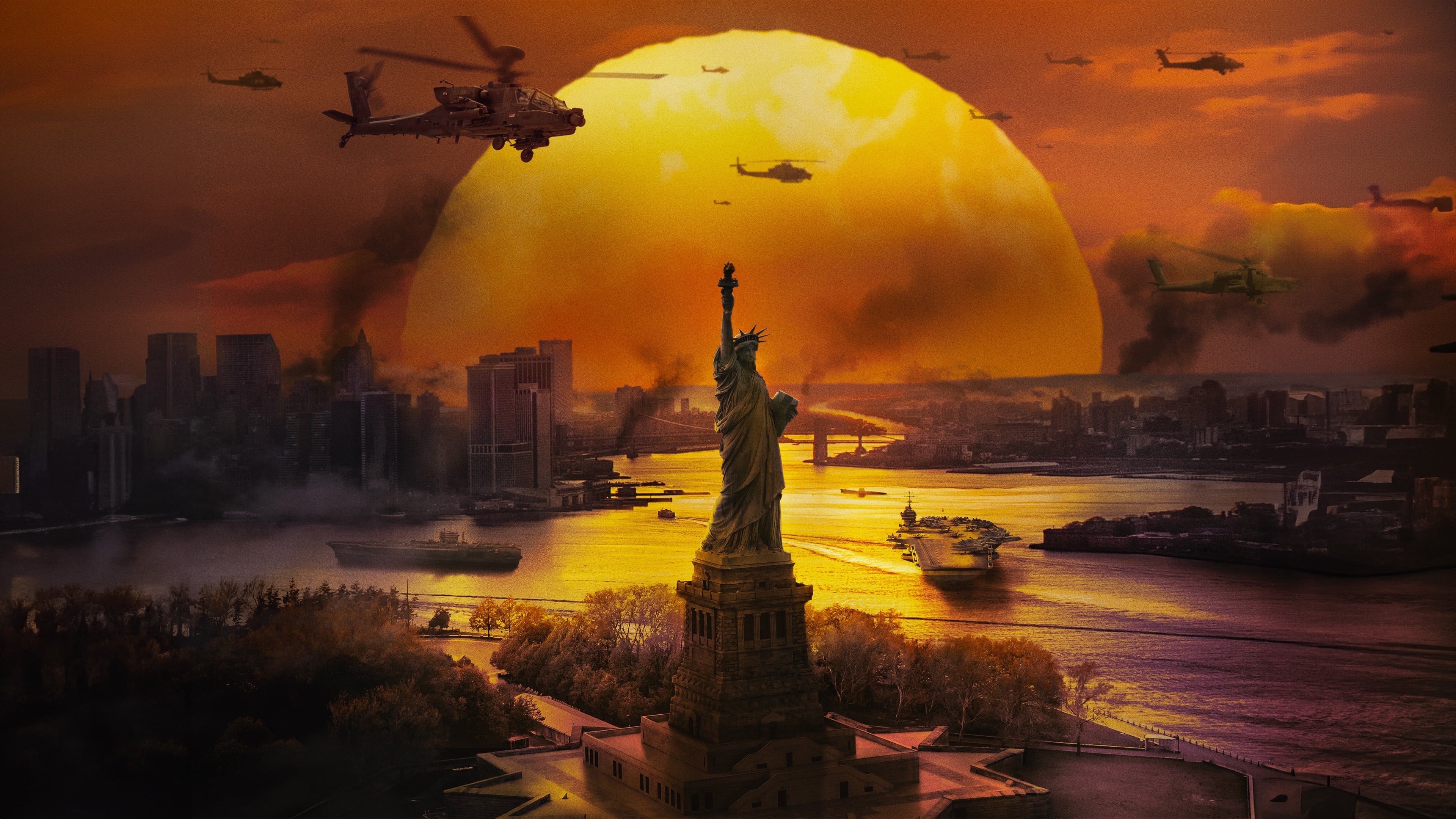
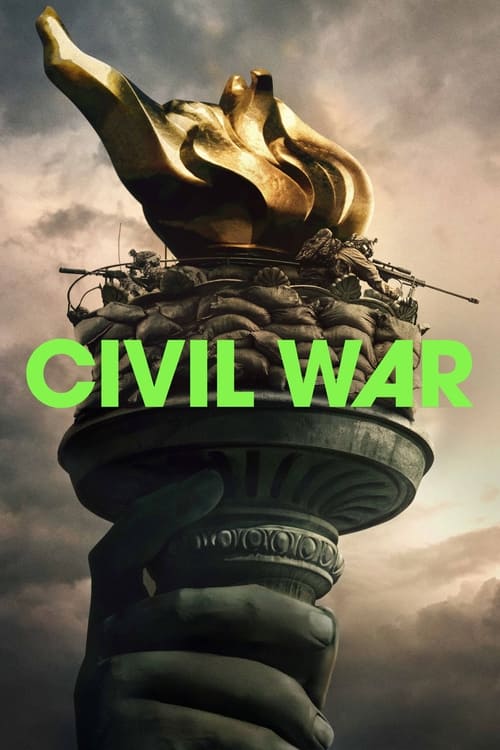
Alex Garland’s Civil War opens with a president (Nick Offerman, uncredited and chilling) rehearsing a victory speech in the mirror while, outside, America is eating itself alive. It’s a small, almost darkly comic moment, and it tells you everything about where this film’s sympathies lie. Not with the politicians. Not with the rebels. With the people holding cameras, trying to make sense of the wreckage. This Civil War review has been sitting in my head since the film dropped in April 2024, and over a year later, I’m still not sure I’ve fully processed it.
That’s probably the point.
Garland didn’t make the film people expected. Audiences walked in wanting a political thriller that would pick a side, explain who the good guys are, and deliver the kind of cathartic resolution that American cinema usually trades in. What they got instead was a war film that refuses to contextualize its own war, filtered through the lens of combat journalism. And a lot of people hated that choice. A lot of people loved it. Both groups are right, in their own way.
Kirsten Dunst Carries the Weight
The smartest decision Garland made was centering the film on Lee Smith, a war photographer played by Kirsten Dunst in what might be the best performance of her career. Lee isn’t a hero. She’s not even particularly likable for large stretches. She’s burned out, dissociated, and running on professional instinct more than anything resembling conviction. Dunst plays her with this hollowed-out exhaustion that feels earned, not performed. You can see in her eyes that she’s seen too much and developed too many coping mechanisms to feel anything cleanly anymore.
The dynamic between Lee and Jessie (Cailee Spaeny), the young aspiring photojournalist who tags along for the road trip to D.C., gives the film its emotional spine. Jessie is eager, naive, still capable of being shocked. Lee was Jessie once. Watching Lee watch Jessie discover what war photography actually costs a person is more devastating than any of the film’s considerable action sequences. Spaeny’s been on a tear lately, and her work here sits comfortably alongside her performance in Alien: Romulus as proof she can carry weight in wildly different genres.
Wagner Moura brings a manic, almost reckless energy as Joel, a reporter who seems to enjoy the chaos a little too much. And Stephen McKinley Henderson, as the veteran journalist Sammy, is the film’s quiet conscience. When something happens to Sammy about two-thirds through, it lands like a gut punch precisely because Henderson made him feel so real.
The Jesse Plemons Scene
You can’t write a Civil War review without talking about the Jesse Plemons scene. You know the one. The group encounters a checkpoint manned by armed men in Hawaiian shirts, and Plemons appears as an unnamed soldier who asks the most terrifying question in the entire film: “What kind of American are you?”
It’s the moment the film snaps into razor-sharp focus. Everything before it has been tense but somewhat abstract. This scene is concrete, immediate, and deeply uncomfortable. Plemons plays it with this flat, almost bored menace. He’s not a villain monologuing. He’s a guy with a gun and a worldview, and whether you survive the next thirty seconds depends entirely on whether your answer satisfies him. Garland holds the tension without flinching, and the resolution is abrupt and brutal.
What makes it work is the ambiguity. We don’t know what faction these men belong to. We don’t know their politics. We just know they’ve divided the world into “us” and “them,” and the distinction is lethal. It’s the film’s thesis statement condensed into five minutes.
Garland’s Refusal to Explain
Here’s where the film gets genuinely divisive, and I understand both sides. Garland deliberately withholds political context. We know Texas and California have formed the Western Forces. We know the president is serving a third term and has dissolved the FBI. We know the country is at war. But we never learn the specific ideology driving either side. There are no news anchors providing exposition. No characters sit down and explain why this happened.
Some people find this maddening. They wanted the film to be about this America, these divisions, this political moment. And there’s a legitimate argument that by stripping away context, Garland reduces a deeply specific American crisis into something generic. War is bad. Authoritarianism is bad. These aren’t exactly revelatory observations.
But I think Garland is doing something more specific than people give him credit for. The lack of context isn’t laziness. It’s the point of view of the journalists themselves. Lee and Joel don’t care about the politics. They care about the image, the story, the next checkpoint. The film adopts their professional detachment as its own narrative strategy. You experience the war the way they do: moment to moment, without the luxury of a bird’s-eye view.
Garland pulled a similar trick with Ex Machina, his 2014 directorial debut. That film also withheld easy answers, forcing you to sit with the discomfort of not knowing who to trust. In both films, the ambiguity isn’t a bug. It’s the entire operating system. The difference is that Ex Machina confined that unease to a single building, while Civil War spreads it across the entire country.
Does it always work? No. There are stretches in the middle where the road-trip structure sags, and the episodic encounters start to feel like a video game moving between set pieces. A sniper battle in a small town is technically impressive but emotionally disconnected from what came before. The film is at its best when it’s claustrophobic and interpersonal, and at its weakest when it tries to be a conventional action film.
The Sound Design Will Ruin You
Rob Hardy’s cinematography has gotten plenty of praise, and it deserves it. The film shifts between glossy photojournalism and handheld chaos in a way that keeps you off-balance. But the real technical achievement is the sound design. Gunfire in Civil War doesn’t sound like movie gunfire. It sounds like actual gunfire, sudden and too loud and disorienting. Explosions have a physical concussive quality that makes you flinch in your seat.
There’s a sequence late in the film, during the assault on Washington D.C., where the sound mix goes from overwhelming to almost silent as Lee raises her camera. It’s the film literalizing what she does: she creates a frame around the chaos, and inside that frame, everything goes quiet. It’s a brilliant piece of filmmaking, and it connects directly to the film’s central question about what it means to document suffering rather than intervene.
If you want a comparison point for how a film can use sound to put you physically inside a conflict, 1917 did something similar with its continuous-shot approach during World War I. But where Sam Mendes kept you locked to a soldier’s perspective, Garland keeps you locked to a journalist’s. The effect is different. In 1917, you’re running with the soldier. In Civil War, you’re watching someone watch the war, which is its own kind of horror.
That Ending
The final sequence, the storming of the White House, is both the film’s most visceral section and its most troubling. It’s kinetic, genuinely frightening filmmaking. Soldiers move through hallways. The president cowers. And then it ends with a photograph, the kind of iconic image that defines a conflict. Jessie takes the shot. Lee pays the price.
It’s a devastating ending that works emotionally even as it raises questions it doesn’t fully answer. Has Jessie become Lee? Is the cycle starting over? Garland doesn’t spell it out, and that restraint is either his greatest strength or his most frustrating habit, depending on your tolerance for ambiguity.
A Film That Stays With You
Look, Civil War isn’t perfect. The middle section drags. The refusal to engage with specifics occasionally feels like a cop-out rather than a choice. And some of the secondary characters, particularly the other journalists the group encounters along the way, feel underwritten.
But over a year after its release, I think about this film more than almost anything else from 2024. The Plemons scene. Dunst’s face when she watches Jessie make a choice she can’t take back. The sound of gunfire echoing through an empty American suburb. Garland made a war film that doesn’t glorify or condemn. It just shows you what it looks like when everything falls apart, and asks whether recording it is enough.
If you’re the kind of viewer who needs a film to tell you exactly what to think, Civil War will frustrate you. If you’re willing to sit with the discomfort and do some of the work yourself, it’s one of the most unsettling American films in years. That’s not a comfortable recommendation. But it’s an honest one.
Discover Your Next Favorite Film
Browse our curated collection of movie trailers and find something new to watch tonight.
Browse Trailers